

This Week's Train Your Brain Game
The Recall Challenge

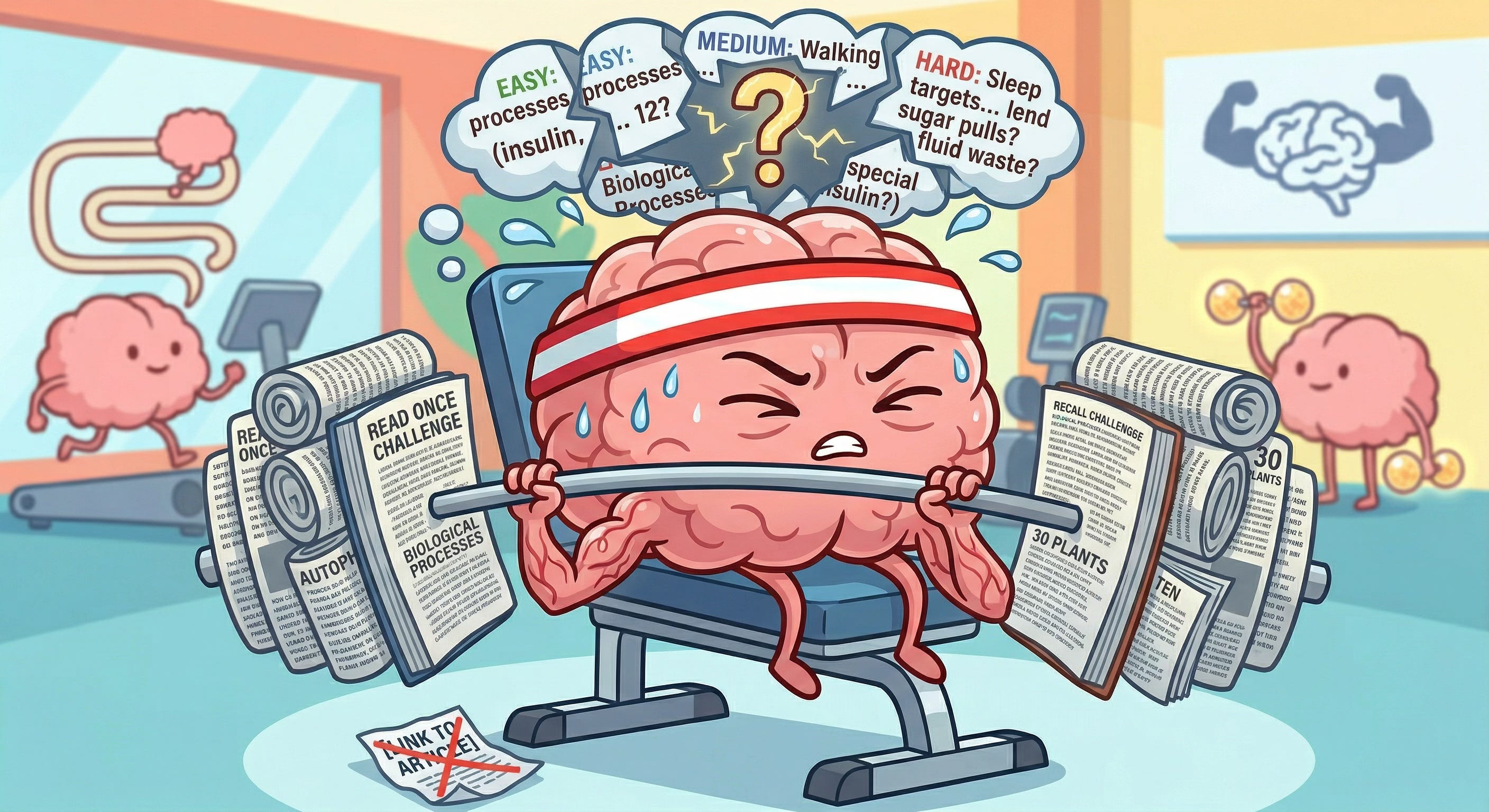
The Recall Challenge
Every answer below is hiding somewhere in this week’s article. The catch: you only get one read-through. No skimming back, no ctrl+F, no peeking. Just your memory against the article.
Here’s why that matters. One of the most replicated findings in brain science is that the harder you work to pull something out of your memory, the stronger that memory gets. Re-reading doesn’t do this. Struggling to remember does. If a clue makes you sweat, that’s the point.
Step 1: Read “What If Ten Habits Could Slow Every Way Your Body Ages?” once, all the way through.
Step 2: Come back here and answer as many as you can without looking back.
EASY (surface facts)
How many biological processes make up the hallmarks of aging?
What is the #1 ranked habit on the list, the one that targets more aging processes than anything else?
What temperature range does the article recommend for your bedroom at night?
MEDIUM (requires understanding)
What protein acts like fertilizer for the protective caps on your chromosomes, and which type of exercise increased its activity while resistance training alone did not?
Why does walking immediately after a meal matter more than walking an hour later?
The article says eating 30 different plants per week beats eating a lot of the same high-fiber food every day. Why?
What happens inside your cells when you stop eating for a sustained stretch, and which habit on the list is specifically designed to trigger it?
HARD (requires connecting ideas)
Sleep targets six hallmarks, more than any habit except exercise. Name three specific things the article says your body does during sleep that it cannot do while you are awake.
The article ranks habits by how many hallmarks they target. What is the only habit that directly targets the hallmark called “genomic instability,” and what does it provide that other habits don’t?
Exercise and sleep both target telomere attrition. But the article describes different mechanisms for each. What does exercise do for telomeres, and what does poor sleep do to them?
ANSWER KEY
(Scroll down only after you’ve given it your best shot)
.
.
.
.
.
.
.
.
.
Twelve.
Exercise — 30 or more minutes, five days per week.
65 to 68 degrees.
Telomerase. Aerobic exercise and high-intensity interval training both increased its activity. Resistance training alone did not.
Contracting muscles pull sugar out of the bloodstream through a pathway that doesn’t need insulin. Waiting an hour lets the spike peak and come down on its own, which eliminates most of the benefit.
Different types of plant fiber feed different bacterial populations. Eating the same food every day feeds one group while the others go without. Variety builds a broader, more resilient bacterial community.
The cell’s internal recycling system (autophagy) activates when nutrient supply drops. Time-restricted eating (Habit #3) is designed to trigger it.
Any three of these: the brain’s fluid-based waste-clearing system flushes out accumulated proteins, repair cells become most active across multiple tissue types, the chemical tags that regulate genes are maintained and reset, and the immune communication system is recalibrated.
Eating 30+ different plant foods per week (Habit #4). It provides a wide range of antioxidants and protective plant compounds distributed unevenly across the plant kingdom that support DNA repair.
Exercise increases the activity of the enzyme (telomerase) that maintains telomeres. Poor sleep is associated with faster telomere shortening over time.
Score yourself:
7 or more correct — your memory and comprehension are firing on all cylinders.
4 to 6 — solid, and the ones you missed are worth re-reading.
Under 4 — re-read the article and try again tomorrow. That gap between attempts is called spaced repetition, and it’s the most powerful memory technique in cognitive science.
This was very interesting and I found it very informative, and reminded me of some of the things I have been learning from Dr. Marbas in other venues. It was not the kind of game I was expecting, but I really appreciated it. I scored 8 out of 10.
Grossly annoying. One cannot complete the task -- can't even begin -- unless one is a paid subscriber.