
Why Some Stroke Patients Can Sing Happy Birthday But Cannot Ask for Water
A 20-year silence, one autopsy, and the brain region that builds every sentence you speak

Welcome to Fantastic Voyage, where we explore the brain one piece at a time. (New here? Start with, What’s Hiding Inside That Three-Pound Lump Between Your Ears? for the big picture, or jump into our tour of the frontal lobe with, There Is a Deformed Little Man Inside Your Head. He Teaches You How Your Brain Controls Every Muscle in Your Body, or What Happens When the Part of Your Brain That Turns Thinking Into Doing Goes Silent?)
The Man They Called Tan
In 1861, a French surgeon and anatomist named Pierre Paul Broca was called to examine a patient at a hospital in Paris. The patient’s legal name was Louis Victor Leborgne, but the staff had long since stopped using it. They called him Tan. They called him that because it was almost the only sound he could make.
Leborgne could understand every word anyone said to him. His tongue and vocal cords worked fine. There was nothing wrong with the physical equipment of speech. But when he tried to talk, all that came out was a single repeated syllable. Tan. Tan, tan. He varied the intonation and used gestures to get his meaning across, but the syllable itself never changed. He had been communicating this way for over twenty years.
His muscles were not the problem. His brain was. Leborgne died just days after the examination, and Broca performed an autopsy. What he found in the left frontal lobe was a region of damaged tissue, sitting just in front of the motor areas that control the mouth and tongue.
Within two years, Broca had gathered eight such cases. Every one of them had damage on the left side. In 1865, he made one of the most famous announcements in the history of brain science.
“Nous parlons avec l’hémisphère gauche.” We speak with the left hemisphere.
The Speech House
The damaged region is now called Broca’s area. It sits in the inferior frontal gyrus, which is the lower ridge of the frontal lobe, just above the temple. In the numbering system neuroscientists use to label brain regions (called Brodmann’s areas), it occupies areas 44 and 45. Its location is not random. It is right next door to the motor cortex regions that control the muscles of the mouth and tongue. If those motor regions are the hand on the steering wheel, Broca’s area is the navigator calling out the directions.
We have now visited three houses in the frontal lobe. The primary motor cortex fires the signals that move your muscles. The premotor cortex plans which movements to make and in what order. Broca’s area does something similar, but specifically for speech. It is part of a neural network that assembles the sounds of language (called phonemes, the smallest sound units of speech) into the right sequence, and helps build words into grammatically correct sentences.
When Broca’s area is damaged along with the surrounding brain tissue, the result is called Broca aphasia. (Damage to Broca’s area alone tends to produce a milder, often temporary version of these symptoms.) “Aphasia” is the medical term for a language disorder caused by brain damage. People with Broca aphasia speak slowly and with visible effort, and the melodic rhythm of normal speech disappears entirely. They tend to drop small grammatical words like “the” and “is” and “but.” They leave verb endings unfinished. Ask someone with Broca aphasia to describe a picture of a boy and a girl at a picnic, and they might say something like “boy... an’ a girl... an’... a... car... house.”
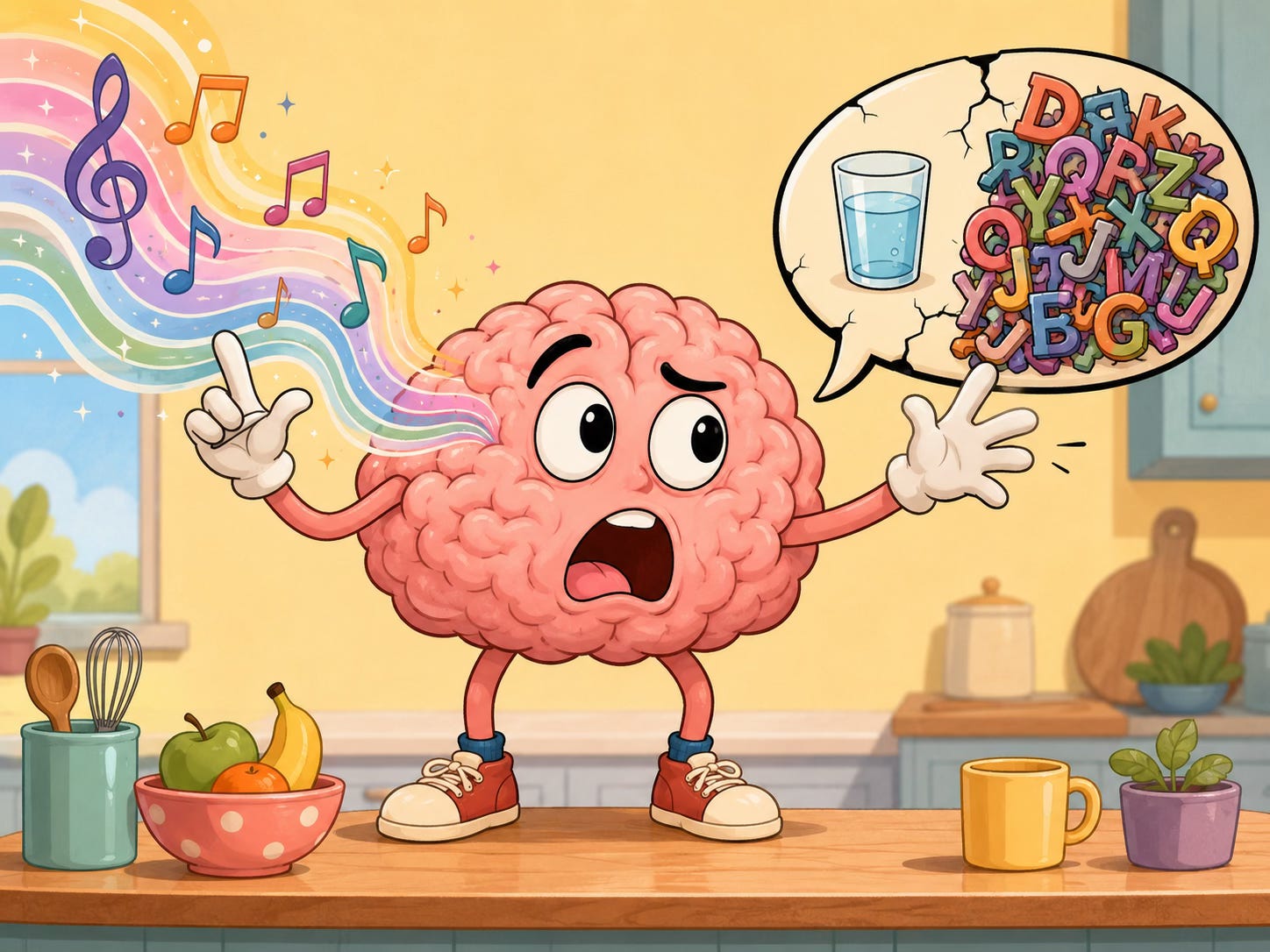
The striking part is that these patients know what they want to say. They can follow casual conversation and pick the right nouns. They are painfully aware that their words are coming out wrong. The thoughts are there, but the translation into spoken language is where things fall apart. (Strangely, many patients with this kind of aphasia can still sing a familiar melody even when they can barely speak, because singing and speech appear to rely on partially different brain circuits.)
More Than a Microphone
For a long time, scientists assumed Broca’s area was only about speech output. The mouth’s production facility. The reality turned out to be stranger.
People with Broca aphasia also have trouble understanding certain kinds of sentences. They can follow simple ones just fine. “The apple that the boy is eating is red.” No problem. Boys eat apples. Apples are red. You can piece that together from the words alone without worrying about grammar.
But try this one. “The boy that the girl is chasing is tall.”
Who is tall? Who is doing the chasing? Either one could be tall. Either one could chase the other. The only way to figure out that sentence is to track its grammatical structure, to follow the thread of who is doing what to whom. Many people with Broca aphasia struggle badly with this kind of sentence. Their grammar processor stalls.
Broca’s area is not just the microphone. It is also part of the brain’s system for building and understanding the structural rules of language. It participates in a kind of verbal short-term memory, holding the beginning of a sentence in mind while you work through the end. When that holding capacity is disrupted, complex sentences become much harder to follow.
The Left Side Rules
Broca’s discovery about the left hemisphere turned out to be even bigger than he realized. About 96 percent of right-handed people depend on the left hemisphere for language processing. Among left-handers, the number drops to roughly 70 percent, with the rest using the right hemisphere or both. Still, the left hemisphere dominates language for the vast majority of the population. And the evidence goes well beyond spoken words. Consider deaf people who communicate with sign language.
American Sign Language is produced with the hands and perceived with the eyes. No sound involved at all. And yet, when deaf signers suffer damage to the left hemisphere, they lose their ability to sign in patterns that parallel spoken-language aphasia. Damage near Broca’s area disrupts sign production and grammar, while damage to other parts of the left hemisphere disrupts sign comprehension. The left hemisphere does not care whether language travels through the air as sound waves or through space as hand movements. It processes the structured system of meaning itself, regardless of how that system is delivered.
That is one of the deeper lessons of Broca’s area. Language does not live in your mouth or your ears. It lives in your brain’s ability to assemble meaning into patterns that follow rules, and then deliver those patterns to someone else. Broca’s area is where much of that assembly happens.
Next up in Fantastic Voyage, we move to the last and largest house on the frontal lobe tour. It is the one in charge of everything else.
References:
Kandel ER, Schwartz JH, Jessell TM. Principles of Neural Science. 4th ed. McGraw-Hill; 2000.
Dronkers NF, Plaisant O, Iba-Zizen MT, Cabanis EA. Paul Broca's historic cases: high resolution MR imaging of the brains of Leborgne and Lelong. Brain. 2007;130(Pt 5):1432-1441. doi:10.1093/brain/awm042